
Historical Committee Report of 2022

On behalf of the World Association of Chefs Societies, we would like to thank the historical committee for their time, expertise and commitment to this project.

Thank you for your support, friendship and passion for the culinary profession. 

– President Thomas A. Gugler and the Worldchefs Team
 

———————————

Dear Worldchefs Community,

I would like to share with you the Historical Committee Report of 2022.

The Worldchefs President Thomas Gugler appointed the Historical Committee in 2017. Since then the committee produced a document relating to the history of Worldchefs Member countries.

37 countries replied 500 copies were printed and distributed at the Congress in Kuala Lumpur in Malaysia in 2018.

In 2020 the Historical Committee was asked by the President to continue with this project and produce an updated report and present at the Worldchefs Congress in Abu Dhabi 2022.

A questionnaire was prepared by the committee and was circulated in June 2021 via the Continental Directors of each regions members. With two reminders from the President, direct contact from the Continental Directors from each region and personal intervention from the members of the Historical Committee we have secured 84 replies as of 24th April 2022.

We have to congratulate the Regions of Europe North,Europe Central and the Americas for a 100% response, of the 103 Worldchefs Member Countries 19 did not reply even after so many reminders.

France, Slovenia, Spain, Cambodia, China, Myanmar, Nepal, Pakistan, Philippines,Vietnam, Kenya, Kuwait, Morocco, Palestine, Fiji, Guam, New Zealand, Papua New Guinea and Vanuatu.

In the 2022 report we will include the information received for the 2018 publication and the updated list of the Worldchefs Honorary Life Members.

A Final report will be prepared with hopefully 100% replies and distributed at the Worldchefs Congress in Singapore 2024.

A little bit of history here as we will celebrate the 40th anniversary of the founding of the Singapore Chefs Association, the hosting of the 2nd Congress after the 1990 Congress which was the first time that Asia hosted this Global Culinary Event.

In closing, l would like to thank the members of the present committee Hazel, Michael, Kurt and Alan and past members Margaret and Norbert for their tireless commitment regarding this project.

Culinary regards,
Otto Weibel
Chairman Worldchefs Historical Committee 2017-2024

Categories
Blog

Healthy and Functional Palm-based Cheese Analogue

What is cheese analogue?

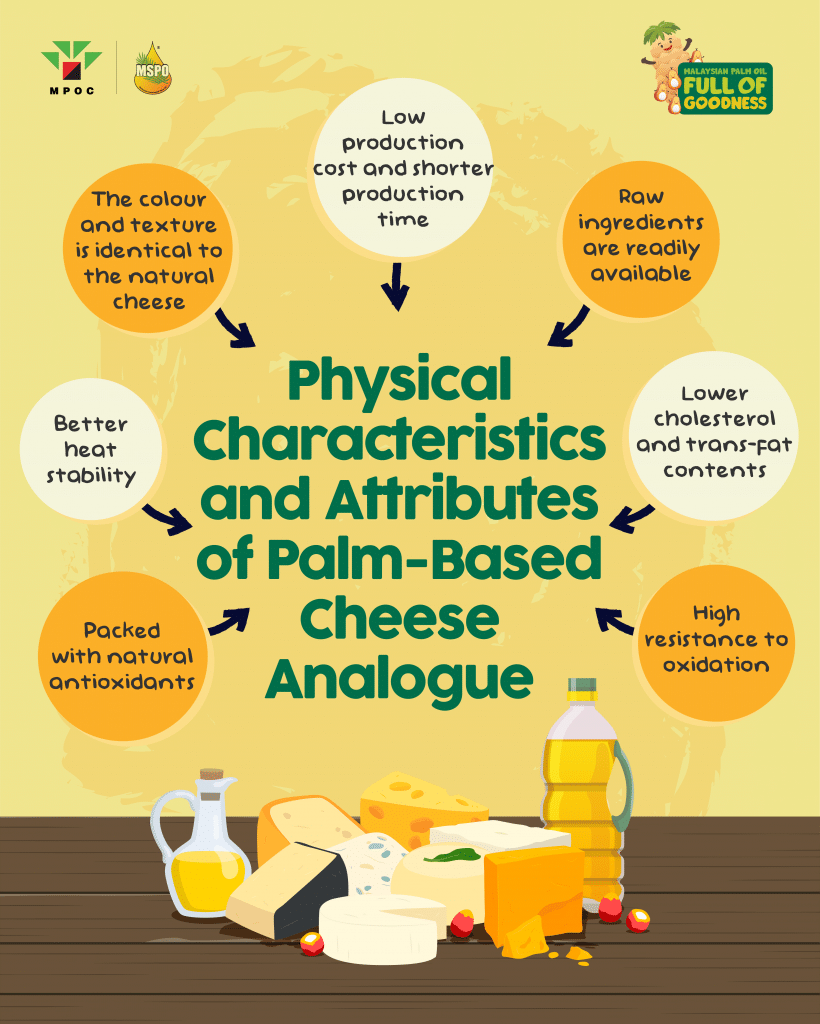
A milk cheese alternative that is identical to natural cheese in composition, appearance, features, and even use.

What is the difference between natural cheese and cheese analogue?

Unlike the usual cheeses, cheese analogues are partially or 100% made from vegetable proteins, fats and oils replacing milk protein and milk fat.

How is cheese analogue produced?

1. Firstly, the vegetable fat component (e.g palm oil) is melted and the temperature is raised up to 70°C.

2. Water is then added to the melted fat followed by fast stirring to form an emulsion.

3. Next, the protein component is slowly added to the mixture to develop the desired texture. Salt, flavour compounds and acid are then added as the drop in pH has a strong effect on texture development.

Why are cheese analogues needed in the food industry?

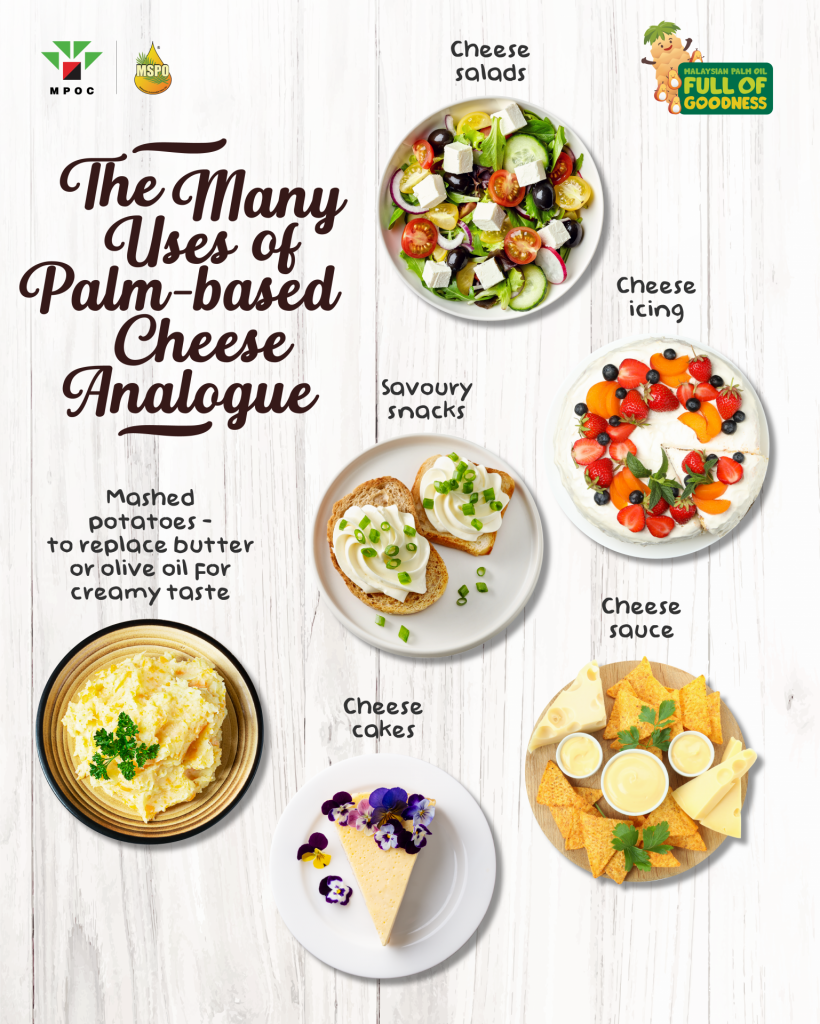
Fast foods and ready-to-eat conventional meals have grown increasingly popular with cheese as one of the preferential ingredients. Dairy-based cheese is more expensive compared to cheese analogue. Cheese analogue is cost effective compared to natural cheese due to the raw materials used. The use of vegetable oils compared to dairy, the low cost of imported casein and the absence of maturation period resulted in a simpler and cheaper manufacturing processes.

Cheese analogue has a diverse array of functionality (flow ability, melt resistance, shred ability, etc.) which is made possible by customised formulations. During storage, they exhibit high functional stability. Moreover, changes in cheese analogue formulation can be made to substitute certain ingredients to fulfil dietary requirements, such as lactose-free, low calorie, low in cholesterol and even vitamin and mineral-enriched.

Do cheese analogues have similar qualities as dairy-based cheeses?

YES. Both dairy-based cheese and cheese analogue are similar in their nutrient profile, organoleptic attributes and their physical appearance. Nowadays, consumers have become completely conscious of the need for better nutrition. Hence, cheese analogues may offer an excellent opportunity to replace a conventional product with a new one that offers the same or better nutritional and texture characteristics.

What is palm-based cheese analogue?

In recent years, to alter sensory, nutritional profile and producing a cholesterol free cheese, vegetable oils are commonly used as milk fat replacers in cheese production. In this case, palm oil and its products are used as milk fat replacer in the production of palm-based cheese analogue. Due to its balanced fatty acids contents, and the presence of natural antioxidants such as tocopherols and tocotrienols that are beneficial towards human health, palm oil is widely used as milk fat replacer in conventional cheese products. In addition to that, many studies have reported the use of palm oil and its products in cheese analogue manufacturing has produced an end product that shows comparable organoleptic attributes with natural cheese, but with better nutrient profile and lower cholesterol contents.

Palm oil is widely used in the production of cheese substitutes such as mozzarella, cream cheese and kashar cheese (sliceable semi-hard cheese). According to Karimah et al. (2001), the use of palm oil in the formulation of mozzarella analogue provides functional properties similar to that of dairy-based mozzarella cheese1. Another study found that palm oil can be used in the production of kashar cheese with higher sensorial scores, making palm oil an acceptable alternative for kashar cheese production that can meet market and consumer’s demand without any significant quality loss2. The Malaysian Palm Oil Board (MPOB) has also developed technology to produce palm-based cream cheese analogue that offers functional versatility to the cream cheese analogue, with the end product’s appearance and texture being nearly identical to dairy-based cream cheese, but with an improved nutritional quality3.

References:

1. Karimah A, Aminah A and Mohd Khan A. (2001). Potential of Palm Blend in the Formulation of Mozzarella Analogue. Palm Oil Developments 35: 1-7.

2. Kavak D.D. and Karabiyik H. (2020). Quality Evaluation of Kashar Cheese: Influence of Palm Oil and Ripening Period. Food Science and Technology 40(2): 354-360.

3. Karimah A. (2010). Palm-based Cream Cheese Analogue. MPOB Information Series. ISSN 1511-7871.

Visit Malaysian Palm Oil Council’s website and follow them on FacebookLinkedIn, and Twitter to learn more about palm oil’s nutritional and economical advantages as well as environmental sustainability.

Categories
Global Chefs Challenge

Global Chefs Challenge Results Are In: See who took home the title of Worlds Best Chef

Global Chefs Challenge Results Are In: See who took home the title of Worlds Best Chef

  • The anticipated Global Chefs Challenge Finals have concluded at the 39th Worldchefs Congress & Expo in Abu Dhabi following four days of intense competition.
  • After years of training and preparation, the world’s most promising chefs brought their best to the buzzing competition arena.
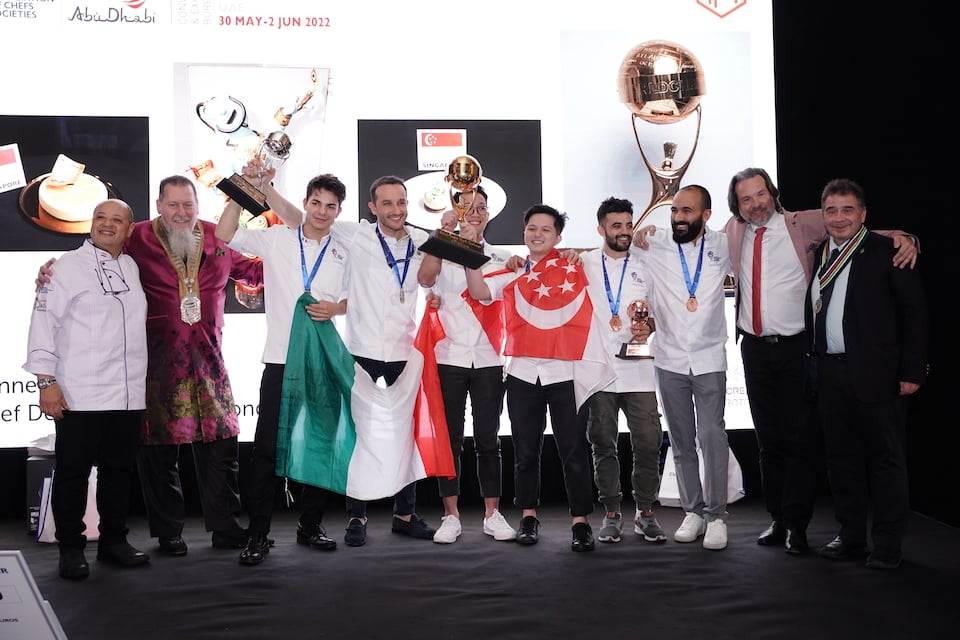
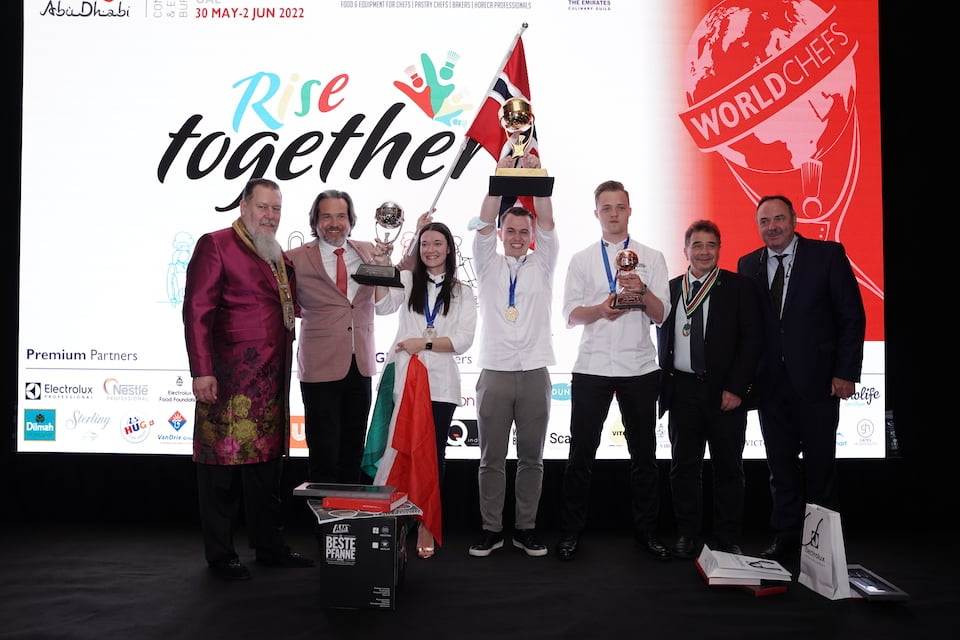
  • Italy, Singapore, and Norway have taken home Gold in the three competition categories: Global Chefs Challenge, the Global Pastry Chefs Challenge, and the Global Young Chefs Challenge. Full results have been made available with National Team rankings and overall scores.

Paris, 3 of June 2022 – The Global Chefs Challenge Finals have concluded at the 39th Worldchefs Congress & Expo in Abu Dhabi. With the backdrop of the historic reunion event, the anticipated Global Chefs Challenge Finals have brought together the world’s top chefs and emerging culinary talent to test their skills on a global stage. After four days of intense competition, the results have been announced.

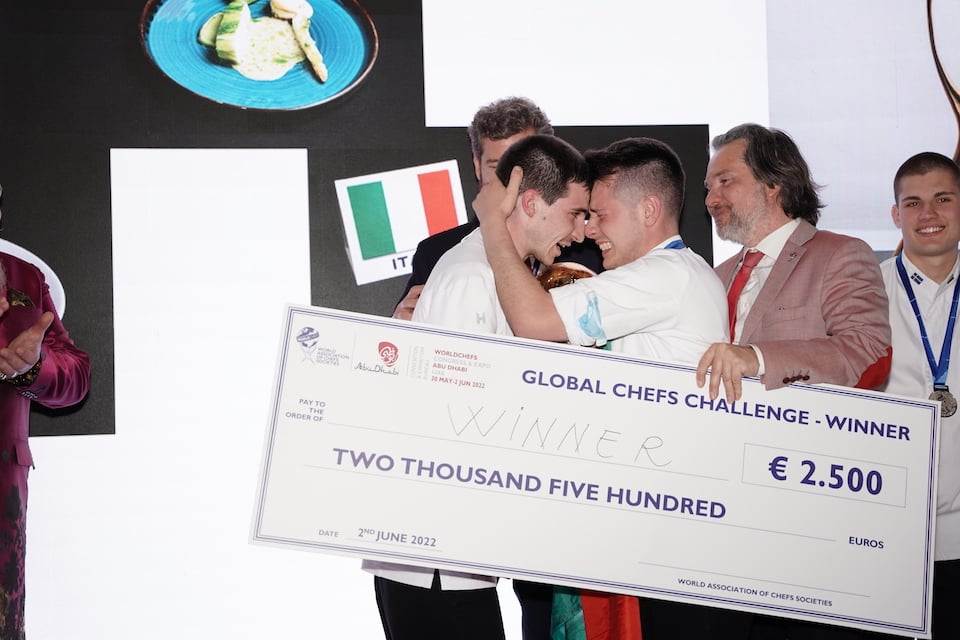
Representing their respective countries and culinary teams, the world’s most promising chefs gave their best in the competition kitchens and at the judging table. Italy, Singapore, and Norway have taken home Gold in the Global Chefs Challenge Final’s three competition categories: Global Chefs Challenge, the Global Pastry Chefs Challenge, and the Global Young Chefs Challenge. Chef Marco Tomasi of Italy now holds the title of Worlds Best Chef.

The Global Chefs Challenge Finals have been a highlight at the 2022 Worldchefs Congress & Expo. The energy of the competition hall reinforced the international comradery that remains the bedrock of the biennial industry event. Congratulations to every participant for their dedication and drive, with years of training and preparation brought to the Global Chefs Challenge competition arena.

  • Global Chefs Challenge Winner – Marco Tomasi (Italy)
  • Global Chefs Challenge 1st Runner up – Michael Andersson (Sweden)
  • Global Chefs Challenge 2nd Runner up – Leong Wei Ming (Singapore)
  • Global Pastry Chefs Challenge Winner – Dexter Lee Chee Leong (Singapore)
  • Global Pastry Chefs Challenge 1st Runner up – Antonio Dell’Oro (Italy)
  • Global Pastry Chefs Challenge 2nd Runner up – Nabil Barina (France)
  • Global Young Chefs Challenge Winner – Aron Espeland (Norway)
  • Global Young Chefs Challenge 1st Runner Up – Giorgia Ceccato (Italy)
  • Global Young Chefs Challenge 2nd Runner Up – Harald Linder (Sweden)
  • Best Tea – Aravinda Leelarathna (United Arab Emirates)
  • Best Fish Global Chefs Challenge – Bartosz Peter (Poland)
  • Best Fish Global Young Chefs Challenge – Aron Espeland (Norway)

Results Ranking: National Teams by Competition Category

Global Chefs Challenge

RankingTeamOverall Score
1Italy94,942
2Sweden92,055
3Singapore91,833
4Poland85,239
5Belgium82,929
6Finland81,310
7Czech Republic80,750
8Hungary79,628
9Slovenia78,738
10South Africa78,398
11England77,679
12Taiwan77,275
13Australia75,737
14United Arab Emirates73,850
15Ireland73,234
16Wales66,036

Global Pastry Chefs Challenge

RankingTeamCakePlated DessertShow-PieceOverall Score
1Singapore85,00090,66591,66589,110
2Italy80,50093,50075,25083,083
3France81,75083,00082,50082,417
4United Arab Emirates71,32581,66590,32581,105
5South Africa59,50081,00066,00068,833
6Qatar57,53963,50067,50062,846
7Egypt54,66566,66566,66562,665

Global Young Chefs Challenge

RankingTeamOverall Score
1Norway95,533
2Italy92,801
3Sweden91,667
4Czech Republic85,812
5South Africa76,910
6Wales76,292
7United Arab Emirates70,768
8United States of America69,867

More information on all three Global Chefs Challenge categories, including complete information on the country competitor profiles and rulebooks can be found at www.globalchefschallenge.org

For live updates, follow @worldchefs on Instagram and @WACSworldchefs on Twitter and Facebook.

– END –

ABOUT WORLDCHEFS

The World Association of Chefs’ Societies, known as Worldchefs, is a dynamic global network of 110 chef associations worldwide. A leading voice in the hospitality industry, Worldchefs carries 91 years of history since its founding at the Sorbonne by the venerable Auguste Escoffier. Representing a mobilized international membership of culinary professionals, Worldchefs is committed to advancing the profession and leveraging the influence of the chef jacket for the betterment of the industry and humanity at large.

Worldchefs is dedicated to raising culinary standards and social awareness through these core focus areas:

Education – Worldchefs offers support for education and professional development through the landmark Worldchefs Academy online training program, a diverse network of Worldchefs Education Partners and curriculum, and the world’s first Global Hospitality Certification recognizing on-the-job skills in hospitality; 

Networking – Worldchefs connects culinary professionals around the world through their online community platform and provides a gateway for industry networking opportunities through endorsed events and the biennial Worldchefs Congress & Expo;

Competition – Worldchefs sets global standards for competition rules, provides Competition Seminars and assurance of Worldchefs Certified Judges, and operates the prestigious Global Chefs Challenge;

Humanitarianism & Sustainability – Worldchefs Feed the Planet and World Chefs Without Borders programs relieve food poverty, deliver crisis support, and promote sustainability across the globe.

For more information about Worldchefs, visit us at www.worldchefs.org.

Subscribe

* indicates required

What are you looking for?

Generic selectors
Exact matches only
Search in title
Search in content
Post Type Selectors