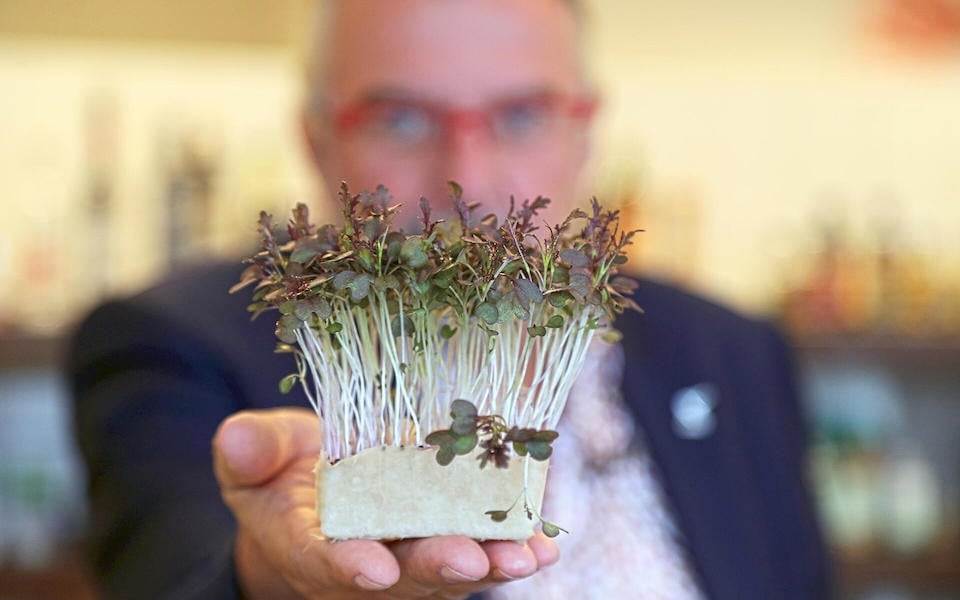
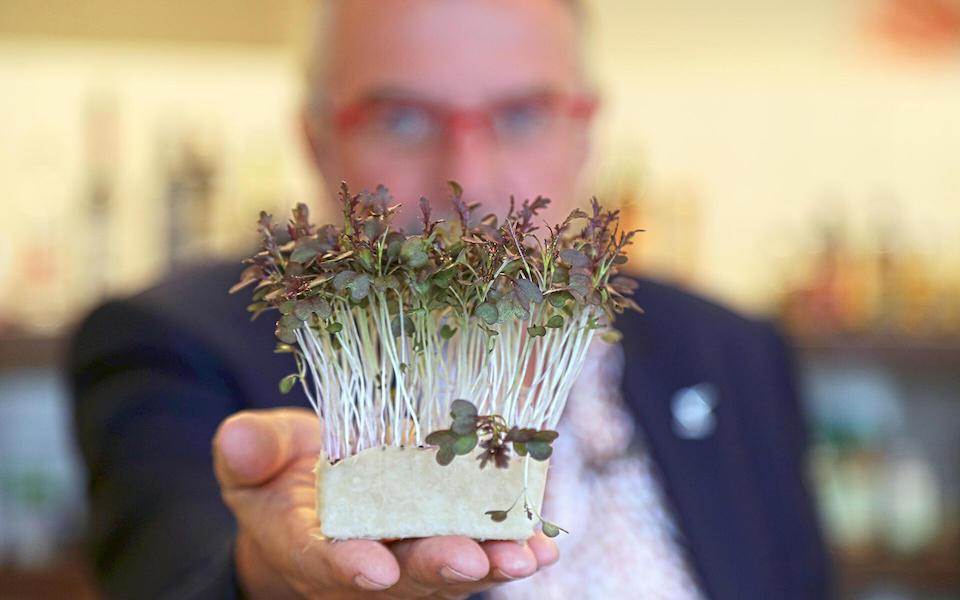
Kyona Mustard Cress has a mild mustard flavour with notes of cauliflower. The colour of the cress gives it a playful character.
Kyona Mustard Cress
Kyona Mustard Cress goes well with hearty meats and fish, such as beef tenderloin or skate wing. It also combines well with different cabbages and potato. A mustard soup is only complete after a topping with fresh Kyona Mustard Cress.
A traditional Dutch product which is still cultivated in the Netherlands today. Visitors to the Netherlands often think that the many yellow fields which can be seen in the summer are rapeseed fields. Actually, most of the fields are mustard fields. Mustard is primarily used as a green fertiliser. But the seed is harvested for Koppert Cress and for the mustard industry.
Kyona Mustard Cress has a mild mustard flavour with notes of cauliflower. The colour of the cress gives it a playful character.
Kyona Mustard Cress
Kyona Mustard Cress goes well with hearty meats and fish, such as beef tenderloin or skate wing. It also combines well with different cabbages and potato. A mustard soup is only complete after a topping with fresh Kyona Mustard Cress.
A traditional Dutch product which is still cultivated in the Netherlands today. Visitors to the Netherlands often think that the many yellow fields which can be seen in the summer are rapeseed fields. Actually, most of the fields are mustard fields. Mustard is primarily used as a green fertiliser. But the seed is harvested for Koppert Cress and for the mustard industry.
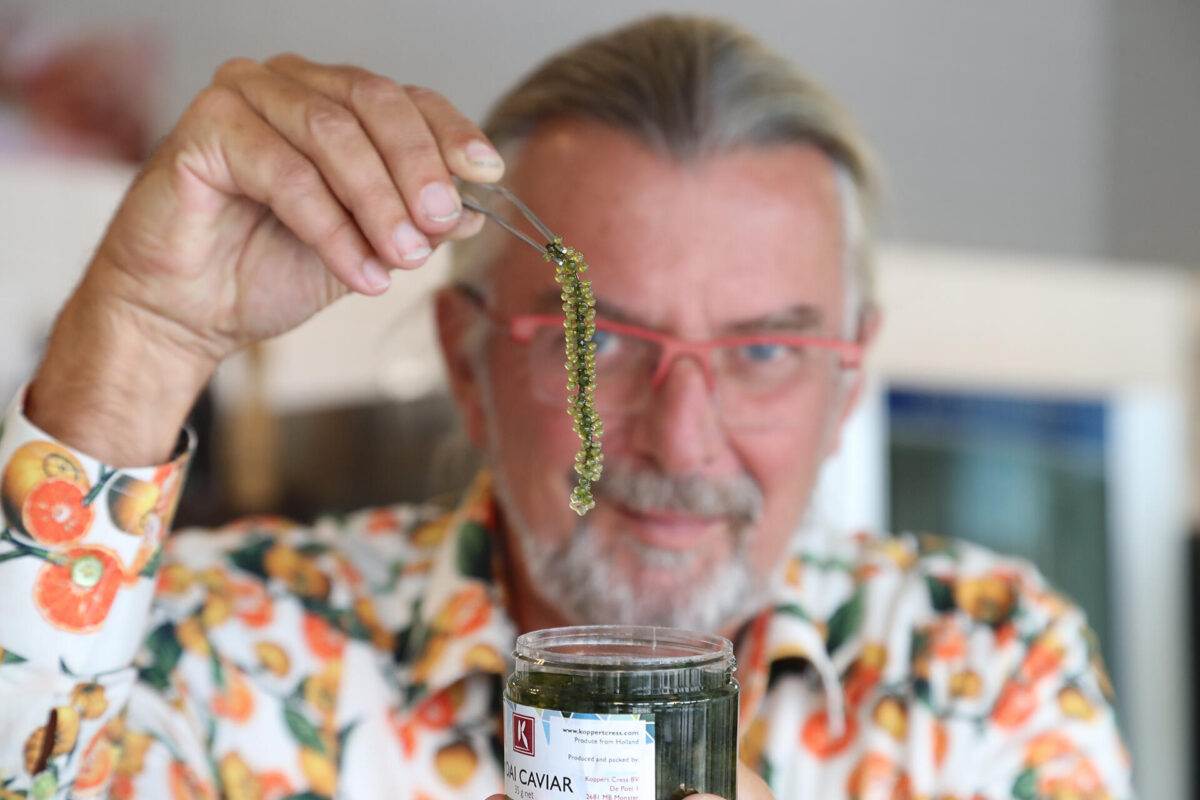
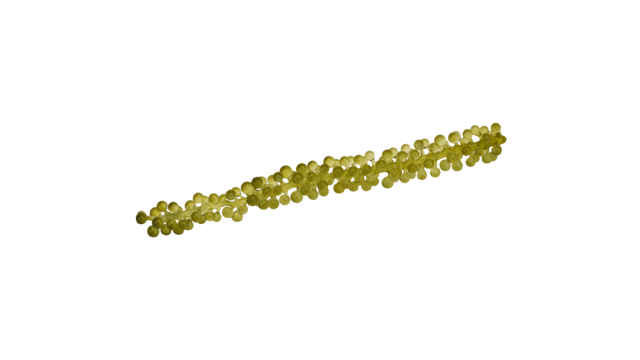
Moai Caviar is known as ‘Umibudo’, the Japanese word for ‘Sea Grapes’ or ‘Green Caviar’. An edible seaweed with tiny bubbles on its stems, which remind us of a small bunch of green grapes or fish roe.
Fresh Seagrapes
The bubbles break easily on the tongue, releasing a slightly salty taste of southern sea freshness. When used raw it is a visually attractive ingredient with a gel-like, aqueous mouth-feeling.
https://youtu.be/emQn_oj_Vp4
The Caviar of Seaweeds
Jonnie Boer (De Librije***)
Dutch 3-Michelin-star chef Jonnie Boer (De Librije *** – Zwolle, The Netherlands) calls it “The caviar of seaweeds” and is very happy with this Dutch version of this seagrape. Together with chef Nelson Tanate they are Moai Caviar in a recently introduced signature dish with oysters, goat cheese, different pickles and salty vegetables.
https://youtu.be/fDlsF0uah3w
Really Fresh
Until now the sea grapes were only available in preserved brine water. With the Moai Caviar this period came to an end. The preserved version is being harvested on the reefs of the Pacific subtropical waters. Before using this preserved version you have to rinse them in tap water to desalinate, the unique bubble-structure comes back partly. With the alternative, the Koppert Cress grown Moai Caviar, you always have the freshest original experience, special mouth-feeling and is ready-to-use.
Rinse lightly, remove access moisture and eat it raw like sashimi. Exposing Moai Caviar quickly to ice water, will enhance the texture and improve the taste. Be careful not to apply dressing from above, because the sea grapes will wither as a result.
Origin
The origin of the word ‘Moai’ is derived from a group of elders in Okinawa, Japan, one of the original Blue Zones. Koppert Cress has always been inspired by the Blue Zones. These live-long friends live an extraordinarily better and longer life than almost anyone else in the world. The origin of the Moai Caviar is traced back to the area of Japan, the Philippines, Thailand and Vietnam. In their natural habitat, the plants grow very fast and are an important source of healthy nutrition for the locals. The sea grapes are being used in a traditional way as salty vegetables, contain some valuable nutrients and all parts of the plants are edible.
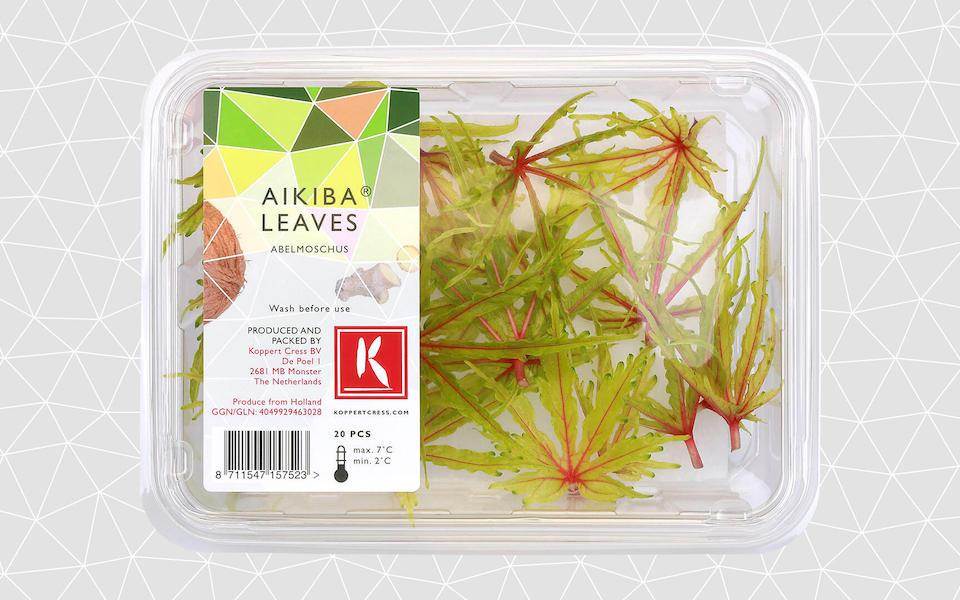
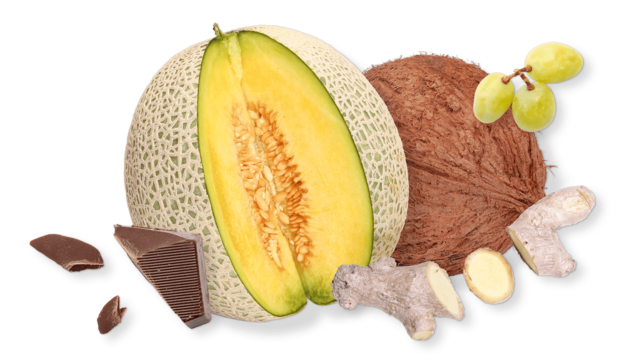
Aikiba® Leaves are known as ‘lady fingers’, ‘jungle spinach’ or ‘ochro’ and have a light sweet-sour taste. Aikiba Leaves are known as ‘lady fingers’, ‘jungle spinach’ or ‘ochro’ and have a light sweet-sour taste.
Aikiba Leaves
When used raw it is a visually attractive ingredient with a gel-like, aqueous and mushy mouth-feeling. Because the Aikiba Leaves has the visual attractive properties it can be used perfectly in combination with cocktails, tempura creations, creations with an exotic touch or as functional item in several fish, cheese, crustacean or game dishes.
The origin of the Aikiba Leaves is related to the area of Papua New Guinea, The Torres Strait Islands, Tonga, Samoa and Solomon Islands. The plants grow very fast in their natural habitat and are an important source of nutrition for the inhabitants. The leaves are being used in a traditional way as vegetables, contain some valuable nutrients and all parts of the plants can be eaten.
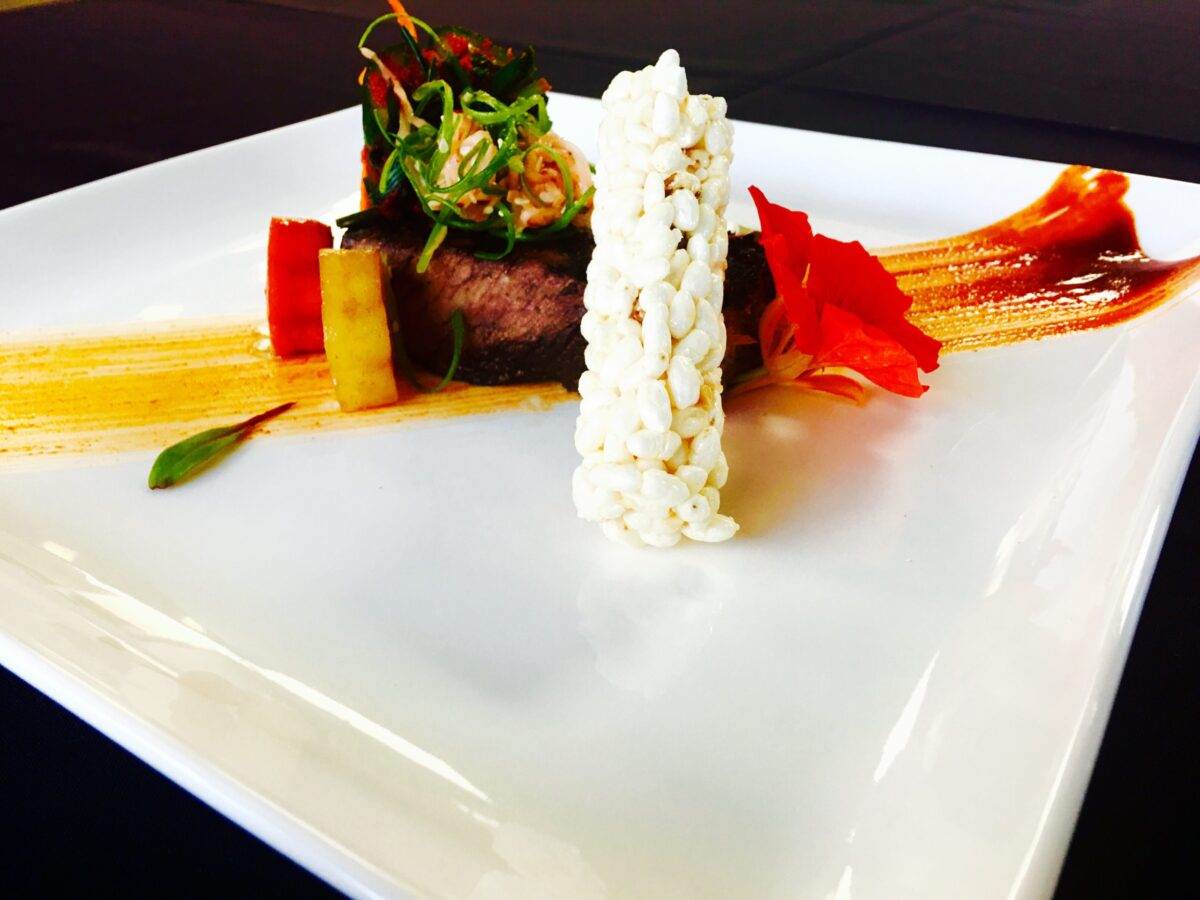
Korean cuisine has so many elements of complexity and technique. These Korean dishes are an interpretation of traditional Korean items, prepared in ‘modern’ format.
Wook Kang
Recipe: Korean Kalbi
Yield: 4 Servings Marinade: 1 Pound Boneless Beef Short Ribs (Prime Grade) 32 oz. Cold Water 1 oz. Brown Sugar 4 oz. Soy Sauce 1 oz. Sesame Oil 2 oz. Yellow Onion, Julienne 14 g. Garlic, Minced 32 g. Scallions, Sliced
Method 1. In a large pot, place the beef short ribs inside and add the cold water.
2. Bring the water to a boil and lower to a simmer. Simmer for 10 minutes, ensuring to skim and degrease as often as possible.
3. After ten minutes, rinse the short ribs under cold water. Remove the ribs from the water and dry very well.
4. On a sheet pan, place the short ribs and rub the brown sugar over the ribs. Allow to sit for 15 minutes. Place the ribs in a sous vide bag and add the soy sauce, sesame oil, onions, garlic, scallions, and ginger. Seal the bag per sous vide machine guidelines.
5. Adjust and heat the water via a circulator and time accordingly to machine guidelines. Once the meat has reached time and temperature doneness, reserve for future use or grill immediately.
Recipe: Ssamjang
Yield: 8 oz. 4 oz. Gochujang 2 oz. Korean Miso Paste (Doenjang) 1 oz. Sesame Oil 14 g. Apple Cider Vinegar 4 g. Sesame Seeds 8 g. Honey 4g. Scallions, sliced thin
Method 1. In a small bowl, combine all ingredients until well mixed and blended.
Recipe: Cucumber Kimchi
Yield: 8 oz.(4 servings at 2 oz. each) 8 oz. Kirby Cucumbers 14 g. Sea Salt or Kosher Salt 25 g. Garlic Chives 24 g. Korean Chili Flakes (Gochu garu) 4 g. Garlic, Minced 8 g. Honey 8 g. Korean Salted Shrimp 4 g. Fresh Ginger, Grated
Method 1. Wash and cut the cucumbers by cross cutting the pieces lengthwise. You should result with 4 to 5 cm (1.5 inch) length cucumber pieces. Put the cucumber into a large bowl then scatter the coarse sea salt around on top. Gently mix them so that the cucumber gets pickled evenly. Set it aside for 20 minutes.
2. Gently brush off the salt from the cucumber then transfer the cucumber into a clean bowl. Add the garlic chives, Korean chili flakes, garlic, honey, Korean salted shrimp, and grated ginger. Toss and mix until well blended.
3. Keep it at room temperature for about 12 to 24 hours then move it to the fridge. Serve once chilled or reserve for future use.
Recipe: Scallion Ginger Salad
Yield: 4 oz.(4 servings at 1 oz. each) 4 oz. Scallions, Julienne 1 g. Sea Salt or Kosher Salt 2 g. Garlic, Fine Minced 1 g. Korean Chili Flakes (Gochu garu) 3 g. Sesame Oil 4 g. Pickled Ginger, Julienne
Method 1. Wash and slice the scallions into julienne pieces. Immediately soak in ice water.
2. Remove and dry the scallion and place them in a small bowl. Add the sea salt, garlic, Korean chili flakes, sesame oil, and pickled ginger. Toss and mix until well blended.
3. Serve once chilled or reserve for future use.
Recipe: Sweetened Puffed Rice Sticks
Yield: 8 Puffed Rice Sticks For Crispy Rice: 1 cup Short grain white rice 1 1/2 cups Water To Taste Kosher Salt 16 oz. Canola Oil (For Deep Frying)
Method To make the crispy rice: 1. Place the rice water and salt into a medium saucepan. Bring to a boil, cover, and reduce to a simmer. Cook for 20 minutes. Remove from the heat and let it sit, covered, for another 10 minutes.
2. Pre-heat the oven to 250º F.
3. Spread the rice out onto a small baking sheet. Bake (dehydrate) in the oven for 2 hours. The rice should be dry and hard when it’s done. Place the rice into the fridge to cool off for at least an hour.
4. The last step is important, to puff the rice. In a medium saucepan, add enough oil so that it comes up to about 1/2″ on the side, and heat the oil over medium heat until it’s shimmering. Test to make sure it’s ready by adding a single piece of rice to the oil. If it sizzles all around the rice kernel, then it’s ready. Add about half of the rice to the pot and cook for about 30 seconds, just until the rice puffs up. This happens very quickly, and you do not want to overcook it, otherwise the rice will be too crunchy. Use a slotted spoon to remove the rice and place it onto a paper-towel lined plate. Do this until all of the rice is puffed.
To make the Rice Sticks: 1. Place 1 cup of the crispy rice (or puff rice cereal) into a large mixing bowl.
2. Place the brown rice syrup, salt, and vanilla into a medium saucepan. Heat over low until the syrup is melted and you can stir everything to combine. Once the mixture is smooth and mixed, pour directly into the bowl with the puffed rice. Stir until everything is evenly combined.
3. Grab about a tablespoon size of the mixture and roll it between your palms to form a stick (you may use a mold). Repeat this until all of the sticks are formed.
Plating Components/Assembly:
1. On a square plate, brush the ssamjang sauce with a pastry brush across the plate from one corner across another corner.
2. Place the grilled short rib in the center.
3. Place one piece of cucumber kimchi next to the short rib.
4. Place one piece of the sweet rice stick across the top from the cucumber kimchi.
5. Arrange the scallion salad on next to the grilled short rib.
6. Garnish the plate with micro bulls’ blood, micro lettuce, and one nasturtium flower.
About the Author
Born in South Korea and raised in Chicago, Illinois, Chef Wook Kang had an interest in food at an early age. Having been influenced by his Korean heritage and the melting pot of cuisines in Chicago, his love of cuisine led to a career in food. He has held positions at prestigious restaurants that would inspire his creativity and the appreciation of food of all cultures. The lessons and inspirations he learned from there, provided the philosophies he has established as a professional, showcasing those skills at Kendall College. Prior to joining Kendall College, Chef Kang served as the Program Chair/Director at Le Cordon Bleu. From 2012 to 2014; he was an integral part of CMC trainings across the United States, in addition to providing presentations for the American Culinary Federation and other organizations. Chef Wook Kang holds certifications through the ACF as a Certified Executive Chef (CEC), and also holds certifications as a Master Certified Food Executive (MCFE) and Certified Food and Beverage Executive (CFBE).
Chef Wook Kang
We use cookies on our website to give you the most relevant experience by remembering your preferences and repeat visits. By clicking “Accept All”, you consent to the use of ALL the cookies. However, you may visit "Cookie Settings" to provide a controlled consent.
This website uses cookies to improve your experience while you navigate through the website. Out of these, the cookies that are categorized as necessary are stored on your browser as they are essential for the working of basic functionalities of the website. We also use third-party cookies that help us analyze and understand how you use this website. These cookies will be stored in your browser only with your consent. You also have the option to opt-out of these cookies. But opting out of some of these cookies may affect your browsing experience.
Necessary cookies are absolutely essential for the website to function properly. These cookies ensure basic functionalities and security features of the website, anonymously.
Cookie
Duration
Description
cookielawinfo-checkbox-analytics
11 months
This cookie is set by GDPR Cookie Consent plugin. The cookie is used to store the user consent for the cookies in the category "Analytics".
cookielawinfo-checkbox-functional
11 months
The cookie is set by GDPR cookie consent to record the user consent for the cookies in the category "Functional".
cookielawinfo-checkbox-necessary
11 months
This cookie is set by GDPR Cookie Consent plugin. The cookies is used to store the user consent for the cookies in the category "Necessary".
cookielawinfo-checkbox-others
11 months
This cookie is set by GDPR Cookie Consent plugin. The cookie is used to store the user consent for the cookies in the category "Other.
cookielawinfo-checkbox-performance
11 months
This cookie is set by GDPR Cookie Consent plugin. The cookie is used to store the user consent for the cookies in the category "Performance".
viewed_cookie_policy
11 months
The cookie is set by the GDPR Cookie Consent plugin and is used to store whether or not user has consented to the use of cookies. It does not store any personal data.
Functional cookies help to perform certain functionalities like sharing the content of the website on social media platforms, collect feedbacks, and other third-party features.
Performance cookies are used to understand and analyze the key performance indexes of the website which helps in delivering a better user experience for the visitors.
Analytical cookies are used to understand how visitors interact with the website. These cookies help provide information on metrics the number of visitors, bounce rate, traffic source, etc.
Advertisement cookies are used to provide visitors with relevant ads and marketing campaigns. These cookies track visitors across websites and collect information to provide customized ads.