Categories
News

Stay Hungry!

Stay Hungry!

The tiger symbolises strength, dynamism and passion. Characteristics that are called for day in day out in the kitchen. The eagerly anticipated reopening of restaurants has so far only experienced a small, cautious upward trend. That’s why it is all the more important at the moment to continue to nurture and maintain the passion for cooking.

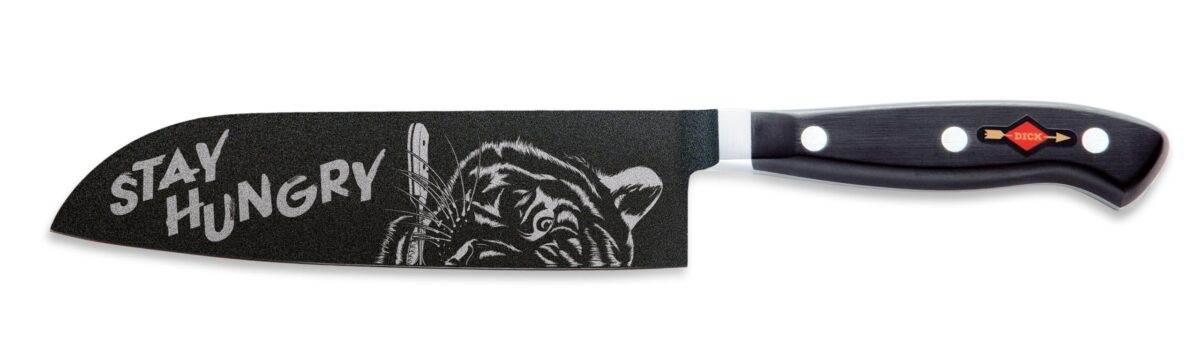
Friedr. Dick would like to embody this with the limited special edition of the forged Santoku knife from the Premier Plus series, featuring the expressive tiger motif and the slogan โ€œSTAY HUNGRYโ€ on the blade. Amongst other things, the tiger also stands for determination and organisational talent, which are also two qualities that have to be present in a kitchen, whether in a commercial setting or at home. Passion, resilience and discipline are required when you train to become a chef and these qualities are fulfilled not only by a tiger but also by the forged Santoku knife. The Santoku knife, originating in Asia, stands for 3 virtues, which represent excellent, versatile properties when cutting meat, fish and vegetables.

The tremendous power of the tiger to overcome this unprecedented crisis should at least be symbolised in the special edition from Friedr. Dick.

Forged from a piece of steel, perfectly balanced and with a high-quality coating on the blade as well as a unique marking โ€“ the perfect tool for creativity and inspiration when cooking. A special reinforced ceramic hybrid coating is applied to the knife blades. This antibacterial non-stick coating reduces cuttings from sticking and allows easy cleaning. In addition, ceramic particles ensure the best sliding properties with reduced force and high wear resistance.

The special edition, limited to 500 pieces, will be available from specialist dealers from October 2020.

Friedr. Dick is the only manufacturer worldwide who offers a complete range of knives, sharpening steels, ancillary items for chefs and butchers as well as grinding machines, sharpening machines and knife cleaning devices. The long-standing tradition and experience of manufacturing products for chefs and butchers allow a continuous development of innovative products. Input from customers, especially end-users and our own ideas are converted into high-quality products.

Further information is available from:

Categories
News

Andalusian “Espeto”

Andalusian “Espeto”

The art of vertical wood-fired grilling
By Luis Soto Villalta.

History

The oldest spit-grilled fish images are in some Egyptian burial chambers. This type of grilling possible was also done in other ancient Mediterranean civilizations. Typical Turkish and Greek vertical roasts as gyros and kebab are proof of this.

The espetos tradition in southern Spain dates to the Muslim era when Muslims brought this type of grilling from the Near East. The cause was the Islam spread and the invasion of the Iberian Peninsula.

This grilling method passed from home cooking to professional cooking in the 19th century. It was by the hand of Miguel Martรญnez Soler when in 1882 he opened his famous bar on the beach: โ€œLa gran parada โ€. It would be the first beach bar โ€œchiringuitoโ€ in the Costa del Sol. Miguel was who started to spike sardines on a piece of cane sinking it on the sand next to the fire. The fame of his espetos spread quickly and on January 21st, 1885, the King of Spain Alfonso XII visited the bar. On Miguel’s advice, he ate sardines with his hands, without knife and fork.

Nowadays, people grill in espetos other species of fish as well as squid and cuttlefish.

How to Prepare a Traditional “Espeto” with Sardines

Preparing the cane:

You must cut one 2.5 to 3 cm diameter cane that is still green into segments of 35 to 50 cm long.

Divide the cane lengthwise into two halves.

Then cut ends of each cane in the shape of a spear tip.

Finally, reduce about 20 cm of cane at the opposite end, which is sunk into the sand, from 2.5 cm to 1.5 cm diameter.

Spiking the sardines:

Season the sardines with coarse salt a couple of hours before roasting.

Thread sardines in a row, all in the same head-to-tail direction to make the grilling uniform.

Cross each sardine from back to belly in half its length. The cane rounded outside must run along the sardine spine and be perpendicular to it.

The sardines must have their back down and their belly up.

Thread the thicker sardine at the bottom of the espeto and the thinner one at the top. When you sink in the sand first, the cane rounded outside faces the fire.

Grilling the espetos:

The olive tree is the best firewood for the espeto. This is because of its resistance, heat power and plenty in Andalusia. The oak wood could be used in other countries where there are not olive trees.

Light the fire and wait until the wood becomes embers.

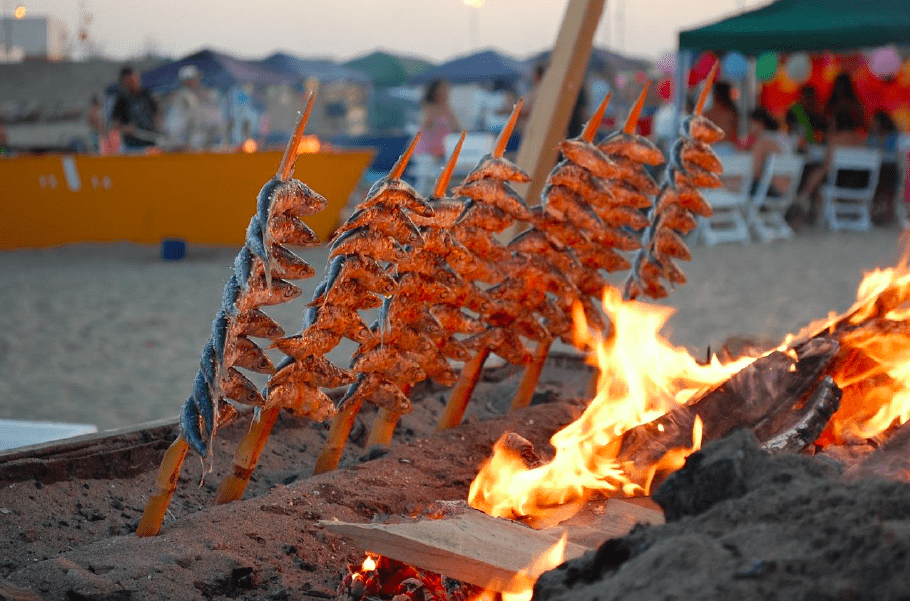
Once you have threaded the sardines, sink the espetos into a small mound of sand. 20- 25 cm from the fire, a little inclined in the direction of the breeze.

The espetos must receive the heat and not the smoke. The flame must never meet the fish.

Grilling ends after 10-12 minutes facing the fire. 5-6 minutes every side.

Serving:

Remove the espetos from the sand and placed on a dish. You must hold each espeto

with one hand and disengages the sardines with the other hand by a slight twist. Serve with some bread and sliced lemon. You can also serve with lettuce. The eatable weight of a sardine in espeto is half of its raw weight.


About the Author

My mother and grandfather introduced me to professional cooking. As people say in Spain: I learned to cook from the bottom of my mother’s skirt. The tradition in the family comes from my grandfather when he founded the first restaurant of the family in 1916. I have later studied both professional cooking and hotel management. I focused my career on kitchen and accommodation management, especially in the rural environment and the wilderness.

Luis Soto Villalta
https://desoto.eu


Feature photo: Espetos in Mรกlaga, Costa del Sol, Spain.

Subscribe

* indicates required

What are you looking for?

Generic selectors
Exact matches only
Search in title
Search in content
Post Type Selectors